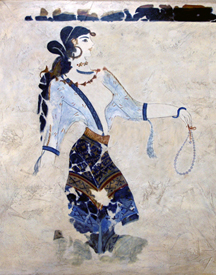
Ancient Minoan Dress
Click here to go to Thomas Baker Paintings Home Page
On Crete and in the Aegean area, around 1700 BC
as depicted on ancient wall murals and painted pottery
(scroll down to see more examples)
by Thomas Baker
Above is my reproduction of a wall mural from Akrotiri on the island of Thera (click to enlarge)
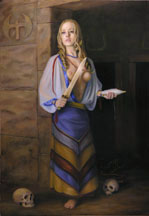
I also replicated the costume shown in the ancient fresco and used it in an original painting, below: "Ariadne"
Prints of these paintings and others on this website are for sale: click here
Below are other examples of ancient Minoan art showing the typical female bare-breasted style of dress
.jpg)
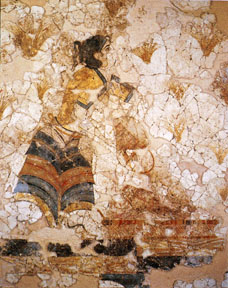
Note in all these images the consistently long, raven-black hair, styled in ringlets.
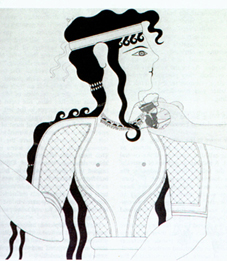

And below, a modern artist's conception of the interior of the palace at Knossos, Crete
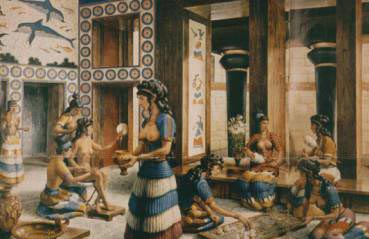
|
Minoan Women's Dress--Description Women's skirts had a basic bell-shape with at least three different variations in form: smooth, with a series of ruffles, or of uncertain cut. The smooth form was fitted at the waist and flared gently to the ground. The ruffle style consisted of several succeeding layers of ruffles gradually increasing in circumference as it approached the ground. The third form, that of uncertain cut, is depicted in drawings and sculptures with a distinct line down the center of the skirt and can be interpreted, as said by Tortora of Survey of Historic Costume, as "either a culotte-like bifurcated garment or as V-shaped ruffles." Women also wore apron-like garments over their skirts that extended to mid-thigh in the front and back. Men and women also wore T-shaped tunics with varying sleeve and skirt lengths. They were commonly decorated along the hem, sides, and shoulderline with bands of woven tape or embroidery. Mycenaean men are more often portrayed wearing tunics than skirts. Women wore bodices composed of smooth fitted lace that fastened beneath the breasts, leaving them exposed, and with short sleeves that fitted the arms closely. In fact these garments are the first sewn, form-fitted clothing; other civilizations of the time used drapery. MINOAN FASHIONS by Bernice Jones From the Archaeology Magazine website http://www.archaeology.org/0005/abstracts/minoan.html comes this commentary, dated May 2000: "Little did I know at the age of six, when I announced to my mother that I was going to be an archaeologist, that I would spend more than 15 years trying to find out what Minoan women wore. My fascination with the subject began when, still an undergraduate, I was first introduced to Minoan art, which reached its high point in the mid-second millennium B.C. I was amazed by the liveliness of female figures captured in motion, by their proud, arched backs and, most of all, by their magnificent costumes, designed to celebrate their curvaceous anatomy. I quickly understood why Sir Arthur Evans, upon discovering the elegantly clothed faience statuettes from Knossos around the turn of the last century, identified them as goddesses or priestesses and why feminists today have adopted them as icons of women's power." "I decided to replicate the costumes and try them out on a model, who would imitate the poses of the figures in art. The tailoring of Egyptian garments had suggested to me that the dresses in Minoan art were realistically portrayed, and I believed that the closer my reconstructions conformed to the representations in art, the closer they would be to the way Minoans really dressed." Bernice Jones |
Thomas Baker Paintings Home Page
Original paintings by Thomas Baker Group 1 | Group 2 | Group 3 | Group 4
Portraits | Old Masters copies | Ancient civilizations reproductions | Prehistoric reproductions | Art lessons | Tutorial DVDs
About the Artist | Contact Thomas Baker